New: run Murmel on your own servers
From today you can license the Murmel speech models and run them in your own environment. Audio and transcripts never leave your network.
Since Murmel launched, I keep getting the same question. From a municipality that wants to write up conversations with residents. From a company that makes recordings for emergency control rooms. From a business that processes thousands of customer calls a week. Every time, the question is: can we run Murmel ourselves, on our own servers?
From today, the answer is: yes.
Murmel already runs entirely in the Netherlands, on Dutch servers. For many users that is enough. But for some organisations even that is a step too far. Their audio is not allowed to leave their own network, or they want to keep processing fully under their own control. For them, the models are now available under licence. This piece covers what you get, how accurate and fast the models are, and how to get started.
Why run it yourself
Speech recognition almost always involves sensitive information. Conversations with citizens, patients, clients or customers. Anyone sending those to an American cloud service needs a good story for it in their DPIA. And more and more often, the answer is simply: we don't want that.
With a licence you run Murmel on hardware you manage yourself. That can be your own servers, or cloud servers you manage yourself. That gives you:
- Full control over your data. Audio and transcripts never leave the building. I have no access to them either.
- No dependence on a foreign service. The model runs on your side, even if something changes elsewhere.
- Air-gapped networks. The model needs no connection to the outside world.
How good is it?
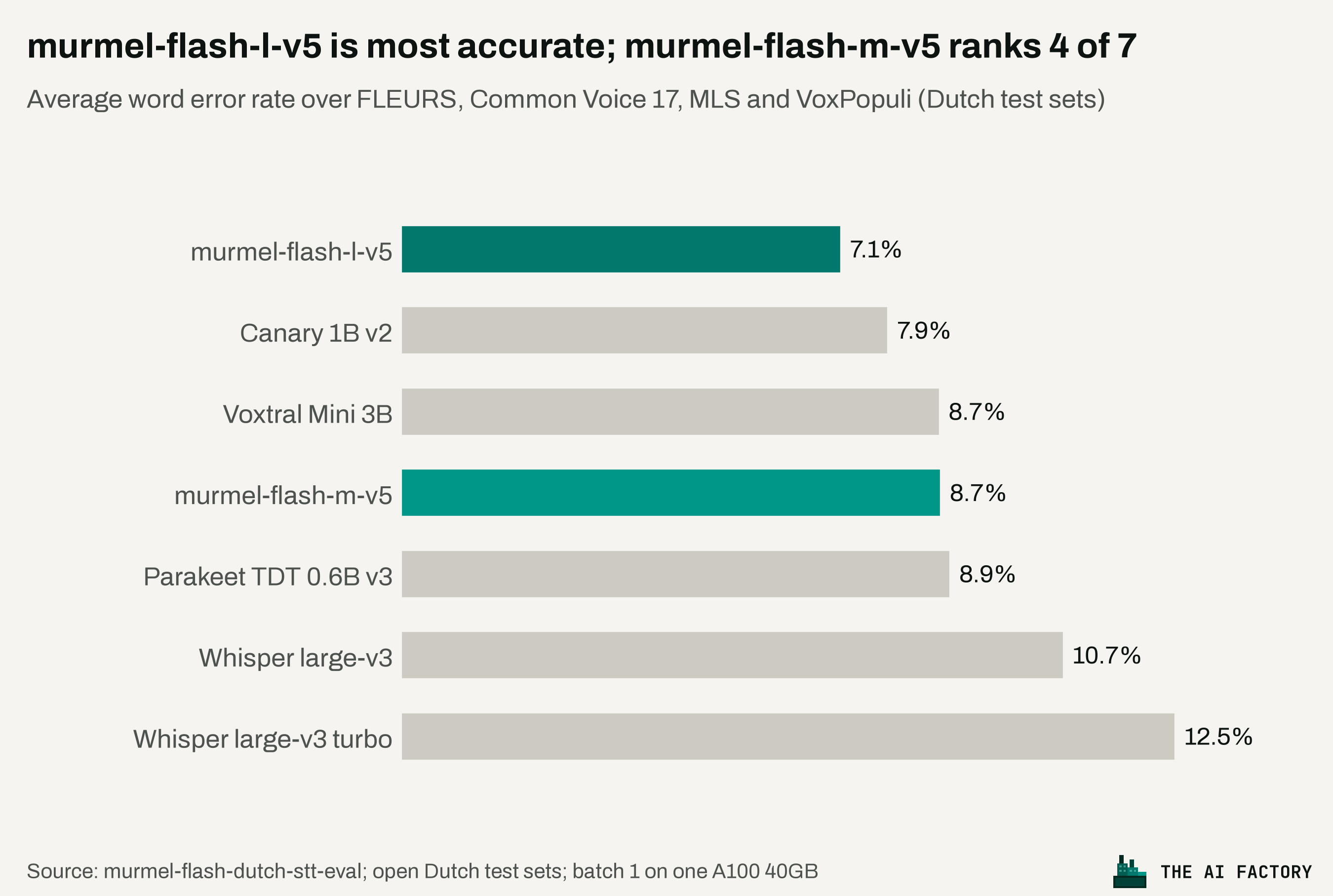
Murmel is not a fine-tuned Whisper, but a model of its own, trained from scratch on Dutch speech. The full benchmarks are in the v5 blog post. In short:
| Model | Average word error rate |
|---|---|
| murmel-flash-l-v5 | 7.1% |
| Canary 1B v2 | 7.9% |
| Voxtral Mini 3B | 8.7% |
| murmel-flash-m-v5 | 8.7% |
| Parakeet TDT 0.6B v3 | 8.9% |
| Whisper large-v3 | 10.7% |
| Whisper large-v3 turbo | 12.5% |
The large model makes a third fewer errors than Whisper large-v3. The small model does as well as Voxtral Mini, a model about 37 times its size.
But averages don't tell the whole story. A few things where Murmel makes the difference in practice:
- Silence stays silent. On recordings without speech, such as rain, traffic or a humming fridge, Murmel outputs text on 3 to 4% of clips. Whisper large-v3 turbo does so on 68%.
- Spontaneous speech. On debates from the European Parliament, Murmel makes less than half the errors of Whisper large-v3.
- Numbers the way you type them. Phone numbers, postcodes, IBANs, amounts and percentages come out the way a person would write them.
- Names and jargon. The model was trained extra on names, loanwords and compounds, the words general-purpose models stumble on most.
And it's fast
Because Murmel has a compact architecture of its own, it is a lot smaller than the well-known alternatives. And smaller means faster and cheaper to run.
| Model | Parameters |
|---|---|
| murmel-flash-m-v5 | 128 million |
| murmel-flash-l-v5 | 397 million |
| Parakeet TDT 0.6B v3 | 600 million |
| Whisper large-v3 turbo | 809 million |
| Canary 1B v2 | 978 million |
| Whisper large-v3 | 1.55 billion |
| Voxtral Mini 3B | 4.7 billion |
The small model is 12 times smaller and 5 times faster than Whisper large-v3. It even runs on an ordinary CPU, so for many applications you don't need an expensive GPU. If you process large amounts of audio, put the large model on a GPU and process more with less hardware than with Whisper.
What you get
There are two subscriptions, both with a fixed yearly fee and unlimited use:
| Flagship | M series | |
|---|---|---|
| Model | The most accurate model, currently murmel-flash-l-v5, plus all models from the M series | The compact model, currently murmel-flash-m-v5 |
| Best for | Highest quality and large volumes on GPU | Running on CPU and local devices |
| Updates | Always the latest flagship model, including new features such as stereo channel processing and improved speaker recognition as they come out | Always the latest version from the M series |
Both include:
- Unlimited use. No limit on hours of audio, servers or number of users.
- Weights and deployment code. After signing you get access to the repository with the model weights, the code to run them and the documentation. Tools such as speaker recognition are included.
- Updates. New versions appear in the same repository.
- Support. I help with installation and configuration, by email or video call.
The licences are meant for commercial use. For personal use, the small model will soon be available for free.
How to get started
- Get in touch at murmel@the-ai-factory.com. Briefly describe what you want to use Murmel for and on what kind of hardware.
- You receive the info sheet. It contains the prices and terms.
- Then the licence agreement follows. After signing you get access to the repository with the weights, the code and the documentation.
Not sure whether Murmel works well on your audio? Try it first at murmel.nl. The same model runs there, and you can test it free for two weeks.
What I learned
When I started Murmel, I mostly thought of a website where you upload a file and get a transcript back. That works well, and Murmel stays that. But the conversations of the past months showed there is a large group of organisations for whom the question is not which model is best, but where the data goes.
This is for them. A Dutch model, made for Dutch, that you keep under your own control.
Want to know whether Murmel fits your organisation, or have questions about the licences? Email murmel@the-ai-factory.com. I'd love to hear what you want to use it for.